
My best post got 2,5K views. A year later, my best gets 50K. Here’s what changed (+7 other lessons)
How to grow a newsletter without paid ads: lessons on share rate, Substack Notes distribution, and finding topics readers forward

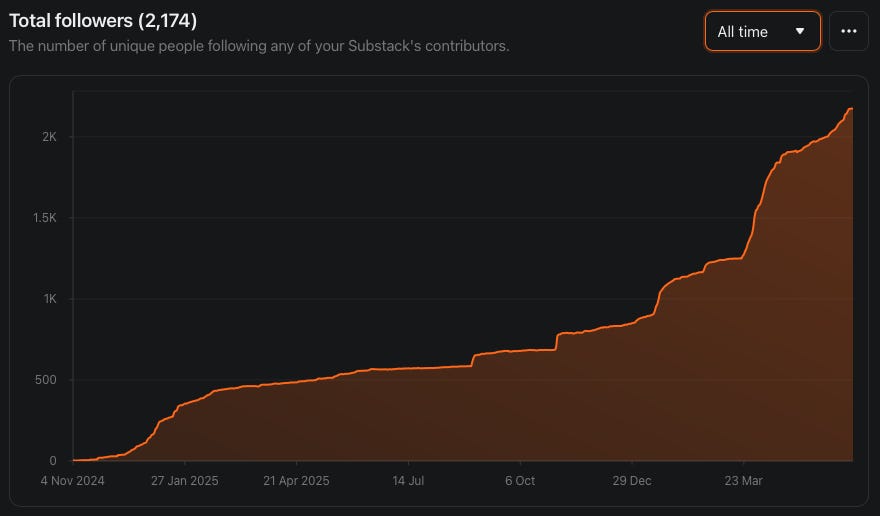
A year ago my most popular post had 2.5K views. Now my two best ones have 50K+ views each. The work is the same. The rest is leverage.
I started this newsletter 18 months ago alongside a full-time job at Amazon and three children at home. I write about meaningful work, productivity under real constraints, and careers that compound. I publish every other week.
I write one post a year to take stock of the numbers and mechanisms that are building my flywheel. I keep discovering more and more. Read the 7 lessons from last year if you are curious.
Lesson 8. It’s not likes, it’s shares
Four months ago I fed Claude all my posts and their numbers and asked what worked. It told me I was measuring the wrong thing. Likes are vanity. Share rate is the engine. Mine was hovering around 1%, so I ignored it as noise.
What is a good share rate? I asked. Turns out:
1%+ share is good
2%+ is strong
3%+ is outlier territory
I was sitting on a post with a 2.9% share rate and had no idea.
Lesson 9. What drives the share rate
So I asked Claude where I can learn more about shareability and who has good insights on the topic. It gave me three sources.
One was Contagious by Jonah Berger. I had already read the book and it didn’t inspire many ideas for my newsletter. It’s an MBA professor type of textbook, useful as a primer on driving word-of-mouth.
The second recommendation was Andrew Chen. He writes about viral products. I earmarked some of his stuff to read later, especially around product engagement and retention.
But the home run was David Perell with his POP writing framework, his Ultimate Guide to Writing Online and his How I Write podcast. I added 20 episodes to my list in one sitting. Three favourites so far: Alex Hormozi on copywriting, Daniel Pink on writing truly useful stuff and Atul Gawande on improving your thinking through writing.
Lesson 10. How this knowledge impacted my share rate in practice
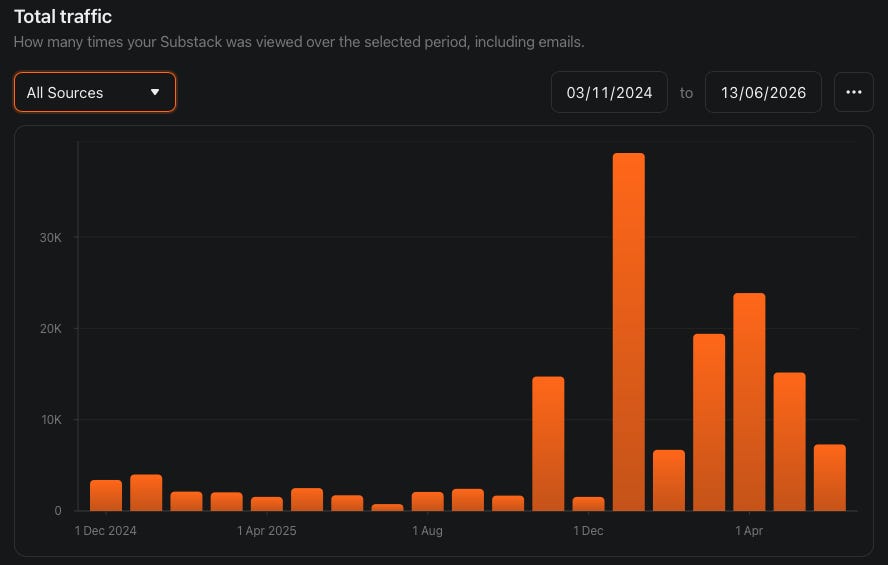
My average share rate went from 0.7% in 2025 to 1.4% in 2026 to date. And here is the graph of the total views for the newsletter since inception:
I have found two things that improve the share rate.
The first is the trigger topic. Starting a new role, for instance. People change roles 13 times on average — and that’s before counting internal moves, promotions, and scope resets.
The second thing is the depth of experience behind the post. The more deeply I experienced the topic, the better share rate it got. I had 6 distinct roles in my 14 years at Amazon and even for the roles I “stayed in” my scope expanded, team and stakeholders changed every year. So I perfected the starting playbook before sharing it. Save it now and thank me later.
I have not yet been able to improve the share rate by spending more time on the post. Better writing improves a post from 1.1% to 1.2%. But the condensed years of usefulness is what drives the gradient up.
That’s why overnight success takes a decade. The usefulness has to accumulate before it can be shared.
I can do it through my own experience, or by interviewing others. This is what Lenny Rachitsky did for his newsletter. It was many instances of wisdom, distilled.
Lesson 11. I stumble on hits in the process of writing
Measuring, learning and optimising lifts the average. But most likely, you will not have your best idea asa result of this analysis. It will come to you in the process of writing. Often, a terrible first draft will turn into your best piece.
Kevin Kelly said it. I lived it.
I was mulling over the draft of my Ultimate Guide to 1:1 post. It didn’t look like a future hit. I kept questioning what value I am adding by writing things that Andy Grove, Ben Horowitz and Julie Zhuo already covered? And then on Friday night, one day before my Saturday publish deadline, it dawned on me that no one really teaches an individual contributor the value of the 1:1. It meant scrapping everything and starting over at 10pm. I did it anyway. That post went to get 50K views and a 4% share rate — the best I’ve ever had.
Lesson 12. Promoting other people’s content brought me 62 subscribers from one note
I have created a marketing routine that I have been using unchanged since the beginning. I write a post (95% of all effort) and then create Substack note, tweet and LinkedIn post. I use Claude to help me with drafts and angles based on the original post and then edit the drafts. The marketing part takes me less than 30 min.
Dave Anderson wrote about high value subscribers coming from LinkedIn so I use that as my main “marketing channel”. Colleagues tell me they like my LinkedIn posts. I want to say: read the newsletter, it’s better. Instead I say: thank you. So far LinkedIn has given me 8% of my new subscribers.
Substack has given me 70% overall (search is 1% and the rest is “direct” or not attributable).
Substack notes brought just over 50% of my subscribers. The notes where I promote my posts, the notes where someone else promotes my post, and — this was a complete surprise — the notes where I promote someone else’s good content. For instance, this note when I restacked Operator’s Handbook post brought me 62 subscribers. Who knew?
These days, inspired by Giacomo Falcone, I started adding second and third promo note. Giacomo is quite active on notes and often reposts very similar notes at different times of the day. I have seen his subscriber and follower growth, so I am stealing his trick!
Some numbers from this experiment:
the first note about promo decisions post got 1,176 impressions and 113 interactions (11% click-through),
for the second one the click-through rate was 8%,
for the third one 7%.
Cumulatively, the follow up notes I measured gave me between 30% to 56% additional click-throughs compared to the original note. So Giacomo is not doing it for nothing.
Another trick I learnt from Wes Kao: I restack when people restack some piece of my content with a note or a quote. Creators should do this more for each other - this lifts interesting “back catalogue” articles and, as I discovered above, drives subscribers for the restacker too.
Finally, as every marketer will tell you, it is much easier to promote a good product. The note saying “This post was shared over 1,400 times” got 62K impressions. Let your winners run.
Lesson 13. The audience is larger than you think
Internet researcher Jakob Nielsen formulated the 90-9-1 rule which breaks community engagement into three tiers:
Creators 1%: The power users who are most actively engaged. They start discussions and drive the conversation. For a newsletter of 2000 subscribers, this is just 20 people.
Contributors 9%: Users who participate occasionally. They comment, reply, or share the creators’ posts. This is the visible part of the audience, another 180 people.
Observers 90%: The silent majority. They read, watch, or consume the content but never respond or actively engage. For the creator these people are not visible. You have to trust that these people are there, they are reading and benefitting from it.
The stage is bigger than it looks from where you’re standing.
Lesson 14. Series decay - part 1 buys subscribers, parts 2 and 3 return to baseline
The research on newsletters suggests that series work to increase subscriber count. It makes sense. If the first post of the series is good, people subscribe to get the next one.
I have tried this approach out of necessity: some posts became too time-consuming, so I have to stop and save the rest for next time.
The first post, indeed, gets a boost of subscribers, but parts 2 & 3 return to average. For instance, part 1 of Senior Manager Guide to AI post had 2.5K views and 60 new subscribers, part 2 had 700 views and only 3 subscribers which was close to my average at the time. Finishing part 3 after this felt like a slog.
My rule now: two parts maximum.
Lesson 15. Testing titles
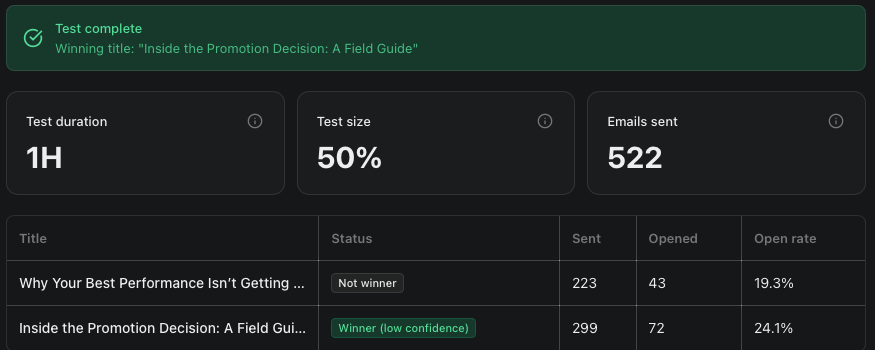
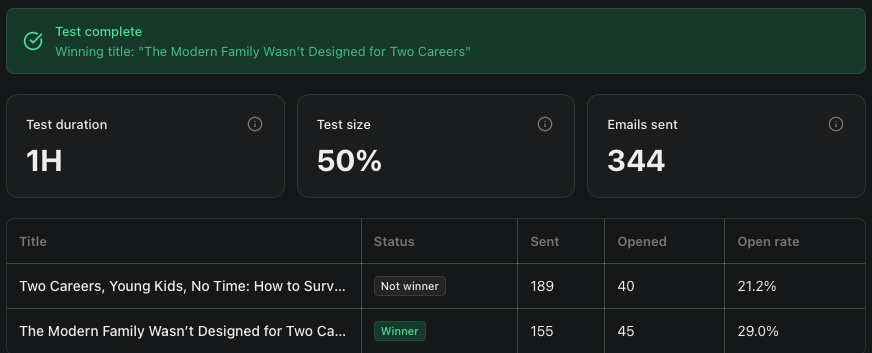
Substack allows to run an experiment on titles. In the first hour of newsletter publish, if I choose to do so, it does an A/B test, sending the newsletter to equal number of subscribers and monitoring which title gets a higher open rate.
It is funny, but the titles I like never win:
My favorite “Why Your Best Performance Isn’t Getting You Promoted” got 19% initial open rate while Inside the Promotion Decision: A Field Guide got 24%.
“Two Careers, Young Kids, No Time: How to Survive The Squeeze” had 21% first hour open rate and The Modern Family Wasn’t Designed for Two Careers got 29%.
Polina vs audience 0:2. I now run the title tests before trusting my instincts.
***
Graham Weaver tells a story on Invest Like the Best podcast when he didn’t make the rowing team his first year in college. They called everyone who didn’t make it “land warriors” and gave them access to rowing machines. He calculated how many people got cut and worked out that he had to show up at 5:30am in order to get a machine to himself, so he did. And - no one else showed up. But he kept coming every morning and after 3 weeks, the only other guy who was rowing so early too, Mike Teti, who was training for the US national team, took Graham under his wing and taught him some things about rowing. By putting in the reps, Graham got on the team, got to captain by his final year and led the team to win the national championship.
Graham’s Mike Teti turned out to be one person. Mine turned out to be hundreds — readers who forwarded a post to a colleague, creators who restacked something I wrote, strangers who sent a one-line reply saying why they subscribed. I am 40 reps in. No idea what rep 80 looks like. I can’t wait to find out.
What I am looking forward to
Do more collabs and content syndication. James Clear pitched his best work to major media outlets and built his subscriber base through it. I haven’t done this yet. That’s my biggest untapped lever. If you’re a creator or editor who might be interested, let me know.
Learn more about Search Engine Optimization (SEO). My SEO knowledge is 20 years old and it shows — only 1.1% of my visitors come from search, and even less from AI. AEO is new SEO re-dressed. I’ve been leaving traffic on the table. Time to fix this.
Get better at marketing. I want to do more marketing experiments. Tom Orbach inspired me to keep a Marketing Inspiration Board — a file where I steal ideas from other creators.
Here is one I am trying today. I have a LinkedIn post promoting this newsletter: HERE. Liking it takes two seconds and shows it to a few hundred of your connections. That’s how many of you found me. TIA!
Choose a name for my newsletter. I need a name for this newsletter. ‘Polina’s Newsletter’ has served me for 18 months but it’s not a brand. My favourite option is High Agency, but George Mack beat me to it. That name was bound to be taken by some highly agentic person.
Get better at writing. I am halfway through Everybody Writes by Ann Handley and Turning Pro by Steven Pressfield. I have Sol Stein On Writing and James Scott Bell Conflict and Suspense on the “to be read” list. How I Write podcast is my walking companion.
Write a useful book. Three book ideas I am thinking about now:
Secrets of the top performers (Things your manager won’t tell you). This one for early career folks. Inspired by my most popular post to date.
A lighter and improved productivity system over Getting Things Done. When people ask me for the best productivity book I know, I still recommend this one (thank you, David Allen). I still use parts of the GTD system 25 years after the book came out, but I chiselled away a lot of the original. It’s kind of like a column in Sagrada Familia compared to a column in a regular gothic cathedral. I feel like his book needs a successor.
The book I couldn’t find when I needed it: a practical guide for working mothers that doesn’t make you angry with the system or your husband. Laura Vanderkam is the best in this space. After her, for a mile, nothing. Cal Newport reads like science fiction for anyone with three children and a full-time job. I want to write the book with actual tools: one that you could read and pass to your partner.
If any of these is a book you’d read, reply with the number 1, 2, or 3. Takes five seconds and genuinely helps me decide.
Thanks to Richard Russell for beta-reading this post.
3 please :)
2 please.